
Calm, capable studying. Right from the kitchen table.
An at-home learning companion for secondary school students that blends AI tutoring, gentle nudges and gamification to cut stress, build steady habits, and turn homework from a battle into momentum.
How can secondary school students be helped to complete academic work from home, without the frustration and stress that so often comes with it? Not everyone has a tutor or a parent free at 7pm.
Astute pairs personalised AI tutoring with strategic, well-timed nudges and light gamification, all grounded in nudge theory and an ethical approach to student data, so studying feels guided rather than overwhelming.
When the school day ends, the gap opens up. Some students go home to tutors and quiet desks. Others face a pile of homework with no one to ask, no plan, and rising panic.
That gap is where frustration, stress and falling grades take hold. The brief was clear: help students complete academic work from home in a way that reduces stress, not adds to it. So I started by understanding exactly where, and why, the support breaks down.

Wealthier families can buy tutoring and time. Low-income households often can't, so support depends on circumstance, not need.

Without guidance, students struggle to break big tasks down and build a realistic plan to actually finish them.

Hours of effort with little to show for it, because no one taught them how to study efficiently in the first place.

Independence matters, but so does knowing when to reach for help. Many students get stuck on the wrong side of that line.
What if every student had a patient, always-available guide, one that lowered the pressure instead of piling it on?
I ran the project end to end through a user-centred double diamond, diverging to understand the real challenge, then converging on a focused, validated solution. Two theories anchored the design.
Nudge theory gently steers students toward productive habits through feedback and timing. Gamification turns progress into something visible and rewarding, so motivation feels natural, not forced.

I went deep on academic literature, government and education reports, the competitor landscape and existing study apps. The same three issues came up again and again: limited resources, poor study routines and a lack of guidance.

One-on-one interviews with families and teachers, plus wider surveys, turned the brief into evidence. A thematic analysis fed into personas and an affinity map, and journey mapping exposed exactly where satisfaction bottomed out.
Students lack the resources and guidance to understand complex topics and finish assignments well.
Anxiety around managing the workload drives procrastination, which drives even more stress.
They can't sustain productive study habits or a consistent schedule, and performance slips.
I mapped a clear structure so students, parents and teachers could each find what they need without friction, reducing cognitive load and making pathways to AI tutoring, schedules and resources obvious. Low-fidelity wireframes pinned down the core flows before any polish.

Because this is student data, I applied Mortier et al.'s Human Data Interaction framework: clear control over data, transparency about how it's used, and real privacy protection. For a young audience, that trust isn't a nice-to-have, it's the foundation.

I evaluated the prototype against usability, content and efficacy with real users, using the Figma prototype to watch where things clicked and where they snagged, then folded that feedback straight back into the design.

Personalised AI tutoring, well-timed notifications and gamified habits, wrapped in a calm interface that organises the work and quietly keeps students moving.


Home, schedule and onboarding from the final design.
To pressure-test the experience, I storyboarded a real moment: Rayan, preparing for his GCSEs, using Astute to organise his tasks, get unstuck and actually finish the work, calmly.
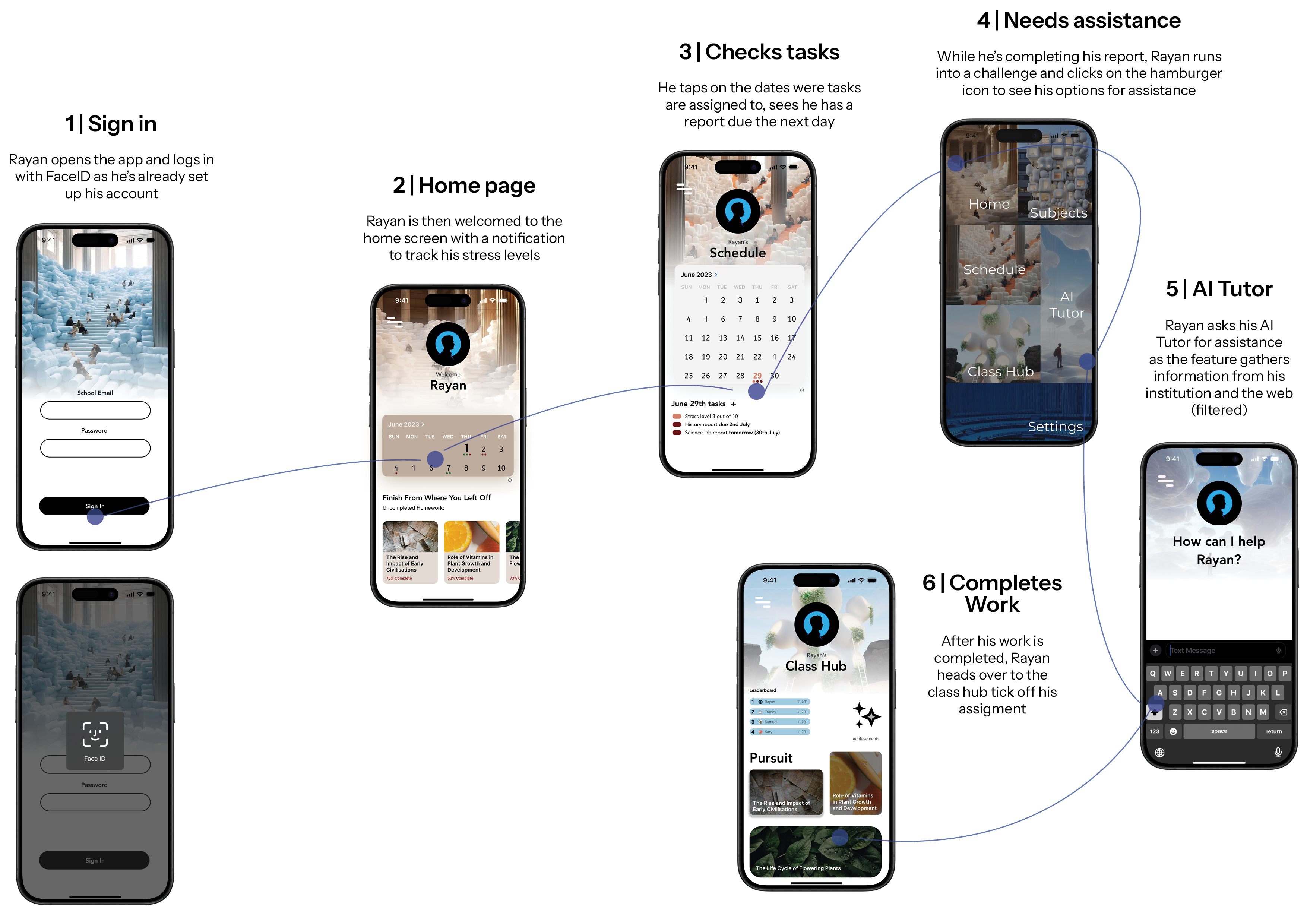
Psychology, used gently, can turn a stressful task into a steady habit, and good design is what makes that feel effortless.
Astute reinforced how much user-centred, iterative design matters in education: nudge theory to drive motivation, data privacy to earn trust, and continuous testing to keep it honest. Grounded in real student feedback, thoughtful design can genuinely make learning feel lighter.
Astute · Smart Health · Mo Rezaei · UX & UI Design